

Cast iron cookware has moved from grandma’s kitchen to the forefront of culinary trends, and collectors are paying serious money for the right pieces. Some vintage skillets now sell for hundreds of dollars at auction. What makes one pan more valuable than another? Discover which rare skillets belong on your radar and why they’re worth the hunt.
Griswold “Erie” Spider Skillet
Made in the late 1800s, the “Erie” Spider Skillet is one collectors hunt for because of its rare spider-in-a-web logo, likely cast around 1890–1891. Griswold even linked the design to the legend of Robert the Bruce, which adds extra charm for history-loving cast iron fans.
Griswold Large Block Logo With Slant “EPU”
These Griswold pans, produced from about 1909 to 1929, stand out with their bold block lettering and the slanted “EPU” mark for Erie, Pennsylvania, USA. Collectors love them for their smooth cooking surface and the fact that this logo style typically commands higher prices today.
Favorite Piqua “Smiley” Skillet
This cheerful-looking skillet gets its nickname from the curved “smile” beneath the Favorite logo. Made in Piqua, Ohio, these pans are easy to spot and fun to own. Because the company shut down in the 1930s, “Smiley” skillets are only getting harder to find.
Wapak “Indian Head” Skillet
Wapak skillets came out of Wapakoneta, Ohio, but the “Indian Head” version is the one collectors treasure most. The detailed Native American profile at the bottom makes it instantly recognizable. Produced from 1903 to the 1920s, these lightweight pans with their ghosting marks are now rare finds.
Wagner Ware “Sidney, O.” Arc Logo Skillet (Pre-1920)
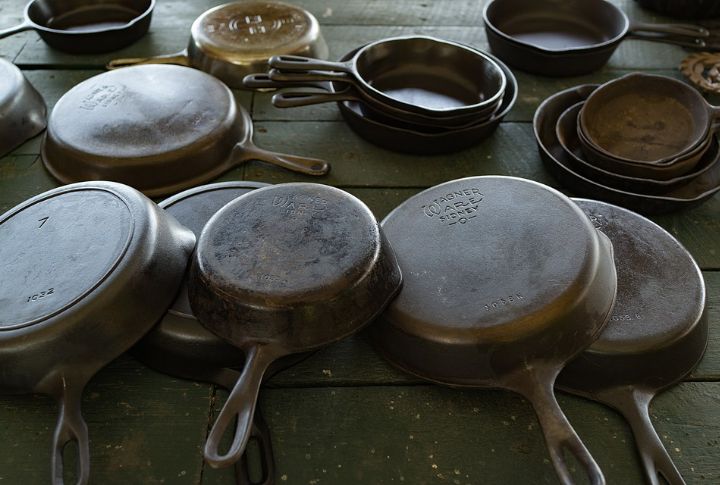
Early Wagner skillets with the “Sidney, O.” arc logo were made in Ohio in the 1910s and 1920s. They’re admired for their lightness and beautiful casting. Wagner, founded in 1891, also became one of America’s most important cookware makers, which makes these pre-1920 arc pieces especially collectible.
Griswold Small Block Logo Skillet (Size Number On Handle)
Griswold’s small block logo skillets came later in the company’s history, generally from the 1930s through the 1950s. They’re easy to date thanks to the simpler logo and the size number cast right on the handle. These details make them both practical to use and fun to identify.
Single-Notch Lodge Skillet (Pre-1960s)
Before the 1960s, Lodge skillets were made with a single notch in the heat ring—a handy way to date them. Produced in South Pittsburg, Tennessee, they’re known for lasting practically forever. Lodge later switched to the three-notch design, but the single-notch pans still feel special to collectors.
Martin Stove & Range “Hamburger Logo” Skillet
Made in Florence, Alabama, from the 1920s to the 1950s, these skillets feature a logo that resembles a hamburger—though it’s actually a stylized stove. People love the quirky nickname, plus the smooth interiors and distinctive handle shapes that make Martin skillets stand out from the rest.
Early Vollrath Skillet With Heat Ring
Early Vollrath skillets include a raised heat ring on the bottom to help them distribute heat evenly on old wood-burning stoves. Vollrath started in Wisconsin in 1874 and still exists today, though cast iron is no longer part of its lineup. Early pieces with unique pattern numbers are highly admired.
BSR “Century” Series Skillet (Pre-1967)
The Birmingham Stove & Range Company made the “Century” series before 1967, and these pans are loved for their thick walls and impressive heat retention. Many have unmarked bottoms, which makes identifying them a fun challenge. Despite the name, the series wasn’t tied to any company anniversary.
